
Guide · emergency checklist
What to Do in the First 24 Hours After Water Damage
The first day decides how much of your home can be saved. Wet materials start to break down, clean water starts to become contaminated, and mold can begin to grow within 24 to 48 hours. Work through this checklist in order.
Updated October 2026 · Water Restoration New York
In the first hour
Stop the water
Close the main shut-off valve, usually on the basement wall facing the street next to the meter. In slab homes, check the garage, utility closet or near the water heater. In apartments, call the super or managing agent.
Make it safe
Do not walk through water near outlets, appliances or the electrical panel. If you can reach the breaker panel from a dry spot, turn off power to wet areas. If you smell gas, leave and call the gas utility from outside.
Get people and pets clear
Keep everyone out from under sagging ceilings and away from sewage or floodwater.
Call for help
Call a restoration company for extraction and drying, and a plumber if the source needs repair.
In the first few hours
- Document everything with video and photos before moving or discarding anything.
- Move belongings out of the water: electronics, rugs, furniture, papers and photos. Put foil or wood blocks under furniture legs you cannot move.
- Report the claim to your insurer and write down the claim number.
- Notify others: your landlord or managing agent, and the neighbor below or above if the water crossed into their unit.
- Start air movement in clean-water areas by opening interior doors. Do not turn on central HVAC if the water is contaminated.
By the end of the first day
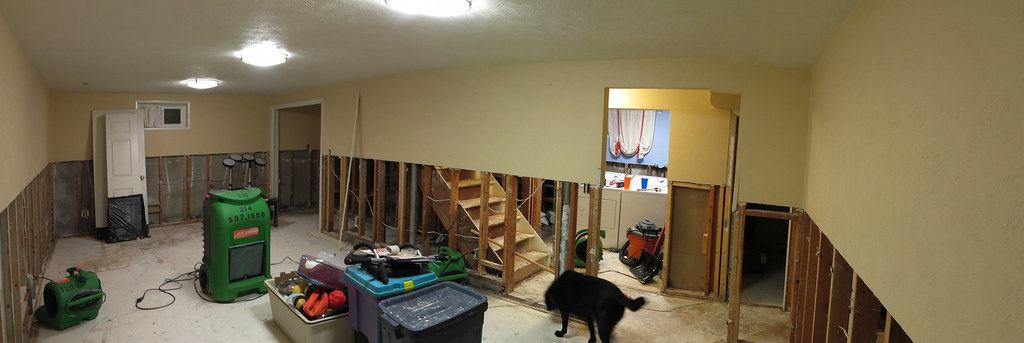
- Extraction should be done and drying equipment set up.
- Wet carpet pad and materials that cannot be saved should be identified for removal.
- Moisture readings should be taken and recorded so drying progress can be tracked.
- You should have a written work authorization and an understanding of what is mitigation and what is repair.
Who to call, and when
| Problem | Call |
|---|---|
| Water still running and the main valve will not close | Your water provider (number on your water bill) to shut the curb valve, then a plumber |
| Panel, outlets or appliances underwater | Your electric utility to disconnect power at the meter |
| Gas smell | Leave the house, then call the gas utility or 911 from outside |
| Sewer backup, neighbors affected too | Your sewer authority and a plumber |
| Cesspool or septic backup | A cesspool or septic service company |
| Leak from the unit above | The super, landlord or managing agent |
| Water in walls, floors, ceilings or the basement | A water damage restoration company |
| Any covered loss | Your insurer or agent, as soon as the water is under control |
Saving belongings
- Photos and papers: separate wet photos and lay them face up to air-dry. Freeze important wet documents in zip-top bags to stop mold until they can be dried properly.
- Electronics: unplug them (only from a dry spot) and do not turn them back on until they have been checked.
- Rugs: roll up area rugs and move them out. Wool and silk rugs should go to a professional cleaner.
- Furniture: lift it onto blocks or move it out. Wipe wood furniture dry and keep it out of direct sun to prevent cracking.
- Anything touched by sewage or floodwater: photograph it, then set it aside for the restoration team to assess. Porous items usually cannot be safely saved.
What not to do
- Do not use a household vacuum on water.
- Do not use electrical appliances or ceiling fixtures in wet rooms.
- Do not lift carpet off tack strips yourself if it is soaked: it is heavy and tears.
- Do not paint over or close up wet walls.
- Do not throw away damaged items before photographing them for insurance.
- Do not touch sewage or floodwater without waterproof gloves and boots.
Special situations
Sewage or cesspool backup
Stop using all water in the house. Keep everyone away from the area. See sewage backup cleanup.
Flooding from outside
Wait until officials say it is safe to return. Have power checked before entering. See flood and storm damage.
Water through the ceiling
Keep people out from under it and turn off power to fixtures in that ceiling. See ceiling leaks.
Common questions
Related questions
Should I turn off the electricity?
Turn off power to wet areas at the breaker only if you can reach the panel while standing somewhere dry. If the panel is in a flooded basement, call your electric utility to disconnect power at the meter.
Can I stay in my home?
For contained clean-water damage, usually yes. Leave if there is sewage in living areas, structural damage, no safe electricity or heat, or if a sagging ceiling is over the only way through the house.
How do I find my main shut-off valve?
Follow the water line where it enters the house, usually through the basement wall facing the street, next to the meter. Turn the handle clockwise, or turn a lever a quarter turn so it sits across the pipe.
When should I call my insurance company?
As soon as the water is under control. Prompt notice is a condition of most policies, and the adjuster may want to see the damage or the photos before materials are removed.
Need hands-on help?
Call (800) 000-0000 to reach a local restoration team, any time.